How to Build an Eye-Catching Creative Portfolio That Gets You Hired
Your portfolio is the single document that can open doors no résumé ever will. In creative fields, it speaks before you do — and for many hiring managers, it's the only thing that truly matters. Getting it right isn't about showing everything you've made. It's about making the right people feel confident hiring you.
Why Your Portfolio Is Your Most Powerful Career Tool
A creative portfolio carries more weight than a résumé because it proves rather than claims. Any applicant can write "strong visual communication skills" — but a well-constructed portfolio demonstrates those skills in seconds.
Art directors, recruiters, and clients spend an average of 15 to 30 seconds on an initial portfolio review. That's not cynicism; it's reality. The goal isn't to overwhelm them with volume — it's to create a first impression strong enough to earn a second look.
Think of your portfolio as a product, not a personal archive. The viewer is the user. Your job is to solve their problem: they need to find someone who can do the work they need done. Every decision you make — what to include, how to organize it, what story to tell — should serve that purpose.
Curate Ruthlessly — Quality Over Quantity
The strongest portfolios contain 8 to 12 carefully selected work samples, not 40 pieces that dilute your best work. Portfolio curation is an editorial skill, and it's one most creatives underestimate.
Start by listing every project you're proud of. Then ask a harder question: which of these would make my target audience — whether that's a UX hiring manager, an editorial client, or an agency creative director — immediately see what I can do for them?
A few practical filters to apply:
- Does this piece reflect the kind of work I want to do more of?
- Is the quality consistent with my other included pieces, or does it drag the overall impression down?
- Does it demonstrate a skill or range that isn't already covered by another piece?
If a project fails two of those three tests, cut it. Showing one mediocre piece alongside five great ones doesn't prove range — it raises doubt. Clients and hiring managers rarely think "that weak piece must have been an off day." They wonder if the strong ones were flukes.
Order matters too. Lead with your most impressive work, not your chronological first project. The second-strongest piece goes last. Everything else fills the middle.
Tell the Story Behind Your Work with Case Studies
Case studies transform a static gallery into compelling proof of how you think. Instead of showing only the final output, a case study walks the viewer through the problem, your process, the decisions you made, and the result.
This matters because hiring managers aren't just buying deliverables — they're buying judgment. A logo is a logo. But a case study that explains why you chose a particular direction, how you navigated client feedback, and what the outcome achieved tells a completely different story about your value.
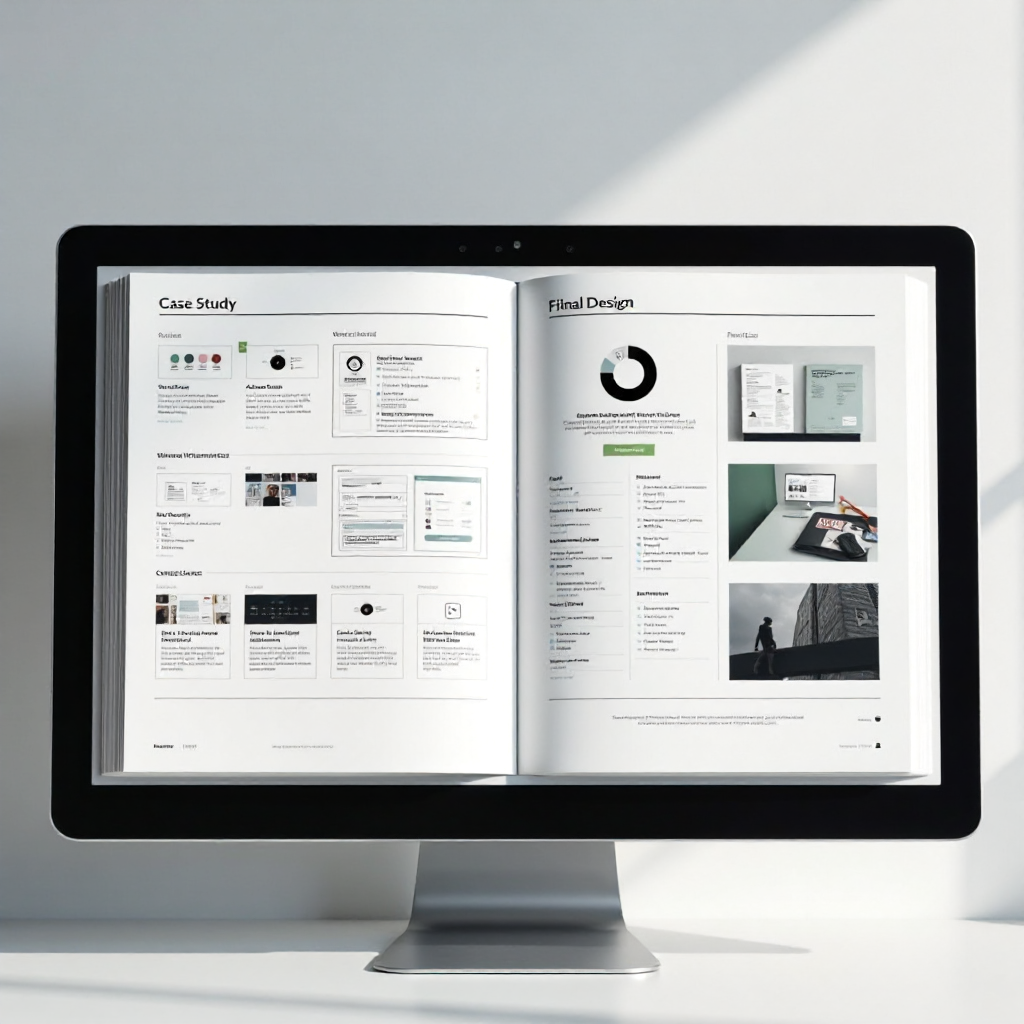
A solid case study doesn't need to be long. Three to five sections work well:
- The brief — what problem needed solving and for whom
- Your approach — research, sketches, iterations, key decisions
- The outcome — final work, measurable results if available, what you learned
Even if you can't share client metrics, you can describe qualitative outcomes: the client launched on schedule, the rebrand helped them enter a new market, the illustration was picked up by a major publication. Specificity builds credibility far more than vague praise of your own work.
Build a Consistent Personal Brand Throughout Your Portfolio
A consistent personal brand signals professionalism before anyone reads a single word. Typography, color palette, tone of voice, and layout should feel cohesive across every page — not because everything needs to match perfectly, but because visual consistency communicates that you understand design as a system.
Your portfolio's visual identity doesn't need to be flashy. It needs to be intentional. A minimalist photographer and a maximalist illustrator will make very different choices — and both can be right, as long as the choices reflect a genuine creative point of view rather than borrowed trends.
Tone of voice matters as much as visual style. The language in your project descriptions, your navigation labels, even your 404 page — all of it contributes to the impression of who you are. A copywriter with inconsistent grammar in their portfolio captions has already told the client something they didn't intend to.
One practical test: remove your name from your portfolio and show it to a colleague. Ask if it feels like a coherent body of work from a single creative voice. If the answer is uncertain, your personal brand needs more attention before you publish.
Choose the Right Platform for Your Creative Niche
The best portfolio platform is the one your target audience actually uses and that presents your work without friction. There's no single right answer — it depends on your discipline, your technical comfort, and how much customization you need.
Here's a practical breakdown by creative niche:
- Graphic designers and illustrators — Behance has a large community and strong discoverability; Adobe Portfolio integrates directly with Creative Cloud and is free with a subscription
- UX and product designers — a custom site (via Squarespace, Webflow, or Cargo) allows the case study depth that UX roles require; Behance is less suited for long-form process documentation
- Photographers — Format and Squarespace offer clean, image-forward layouts with minimal distraction
- Motion designers and video creatives — Vimeo as a hosting backbone, paired with a custom site, tends to outperform gallery-style platforms
Free platforms are a legitimate starting point. The mistake isn't using Behance — it's treating a platform's default layout as a finished portfolio. Customize what you can, and make sure the presentation still reflects your personal brand rather than the platform's generic template.
One non-negotiable: your portfolio must load fast and work on mobile. A beautiful portfolio that takes six seconds to load on a phone loses opportunities before the first image appears.
Write an About Page That Makes People Want to Hire You
Your About page is the second-most visited page in most creative portfolios — and the most commonly wasted opportunity. A bio that reads like a LinkedIn summary tells the viewer nothing memorable about who you are or why they should choose you.
The most effective About pages share three qualities: they're specific, they're human, and they're written with the reader in mind. "Passionate designer who loves solving problems" could describe 200,000 people. "Brand identity designer specializing in food and hospitality brands, based in Lisbon, formerly in-house at a Michelin-starred restaurant group" tells a story that sticks.
Write your bio in first person. Mention your niche or specialization early — it signals immediately whether you're the right fit. Include one or two genuine personal details that make you memorable without oversharing. And close with something that points toward the work: what you're currently focused on, what kinds of projects excite you, or what you're looking for next.
Keep it under 200 words for the primary bio. You can always add a longer version below for those who want more context.
Make It Easy to Take the Next Step — CTAs and Contact
A portfolio without a clear call to action is like a great sales pitch with no phone number at the end. Every page of your portfolio should make it obvious what the visitor should do next — and that next step should require as little friction as possible.
At minimum, your contact information needs to be visible without scrolling on your homepage and accessible from every other page. A dedicated Contact page is standard, but a persistent header or footer with your email address removes one more click from the path between interest and outreach.
Consider what kind of call to action fits your goals. If you're looking for freelance work, "Let's work together" with a linked email or contact form is direct and appropriate. If you're job-seeking, linking to a downloadable résumé alongside your contact details gives hiring managers everything they need in one place.
Avoid making visitors hunt. If someone has spent three minutes on your portfolio and wants to reach you, the moment they can't find your contact information is the moment they close the tab and move to the next candidate.
Frequently Asked Questions
How many pieces should be in a creative portfolio?
Between 8 and 12 strong pieces is the widely accepted range for most creative disciplines. Fewer can work if every piece is exceptional and varied. More than 15 risks diluting the impact of your best work and losing the viewer's attention before they reach the end.
Should I include personal projects or only client work?
Personal projects absolutely belong in a portfolio, especially when they demonstrate skills or aesthetics that your client work doesn't cover. They also signal initiative and genuine passion. Just be transparent — label personal or self-initiated projects clearly so there's no confusion about the context.
How often should I update my portfolio?
Review your portfolio every three to six months. After completing a significant project, add it promptly and consider whether an older piece should be retired to maintain quality. A portfolio that hasn't changed in two years quietly signals stagnation to anyone who's seen it before.
Do I need a custom website or is a platform like Behance enough?
Behance is enough to get started and to be discovered within its community. A custom domain and site becomes important when you're actively job-seeking or pitching clients, because it signals professionalism and gives you full control over presentation. Many working creatives maintain both — Behance for community visibility, a personal site for direct outreach.
What should I do if I'm just starting out and don't have much work to show?
Create work deliberately. Choose a real or fictional brief, solve it as professionally as you would for a paying client, and document the process. Self-initiated projects that show genuine thinking and craft are far more compelling than a sparse portfolio with apologies about being new. Everyone starts somewhere — the portfolio is how you prove you've started seriously.