Behind the Scenes: A Day in the Life of a Professional Artist

A professional artist’s day rarely follows a neat script. It may begin with a half-finished painting, shift to a client email, then return to the studio after lunch with a fresh plan. The work combines a personal creative process with practical tasks that help each piece reach completion, from choosing materials to documenting finished work for a portfolio.
Here’s a grounded look at one possible studio day. The details change from artist to artist, but the balance between making, reviewing, and managing the work is familiar across many art practices.
Starting the Day and Setting Priorities
A professional artist usually starts by checking the plan for the day and choosing a realistic priority. A short review of deadlines, energy, and the current state of each project helps turn a vague intention to “make art” into a workable studio session.
Before opening the sketchbook, an artist might check a project calendar, review yesterday’s notes, and identify the next useful action. That action could be mixing a color palette, drawing three composition studies, or preparing a canvas. Breaking a large commission into smaller steps makes it easier to begin, especially when the final result is still uncertain.
Priorities also depend on the kind of work in progress. A time-sensitive client proof may need attention before a personal series, while a day reserved for uninterrupted painting should be protected from avoidable meetings. A practical daily routine leaves room for both focused work and obligations rather than assuming every hour will be creatively productive.
- Check deadlines: Note what must be sent, reviewed, or completed today.
- Choose one main task: Give the most demanding creative step a clear block of time.
- List smaller tasks: Group messages, supply orders, or file organization into a separate window.
This simple project-planning habit reduces decision fatigue. It does not guarantee inspiration, but it makes it easier to use the time and attention available.
Getting Into the Studio
An artist’s workspace supports the kind of work they make, and a few repeatable setup habits can help them focus. The studio might be a dedicated room, a shared worktable, or a corner that gets packed away each evening.
For a painter, the workspace may include an easel, water jars, brushes, pigments, rags, and a palette arranged within reach. A printmaker may need a press and drying area; a digital illustrator may work with a tablet, computer, and reference monitor. The right art materials depend on the medium, but keeping frequently used tools easy to find saves time and makes cleanup more manageable.
Before starting, an artist may clear yesterday’s scraps, set out only the materials needed for the next stage, and adjust the light. That setup creates a useful boundary between planning and making. It also prevents the opposite problem: spending half the morning reorganizing supplies instead of working.
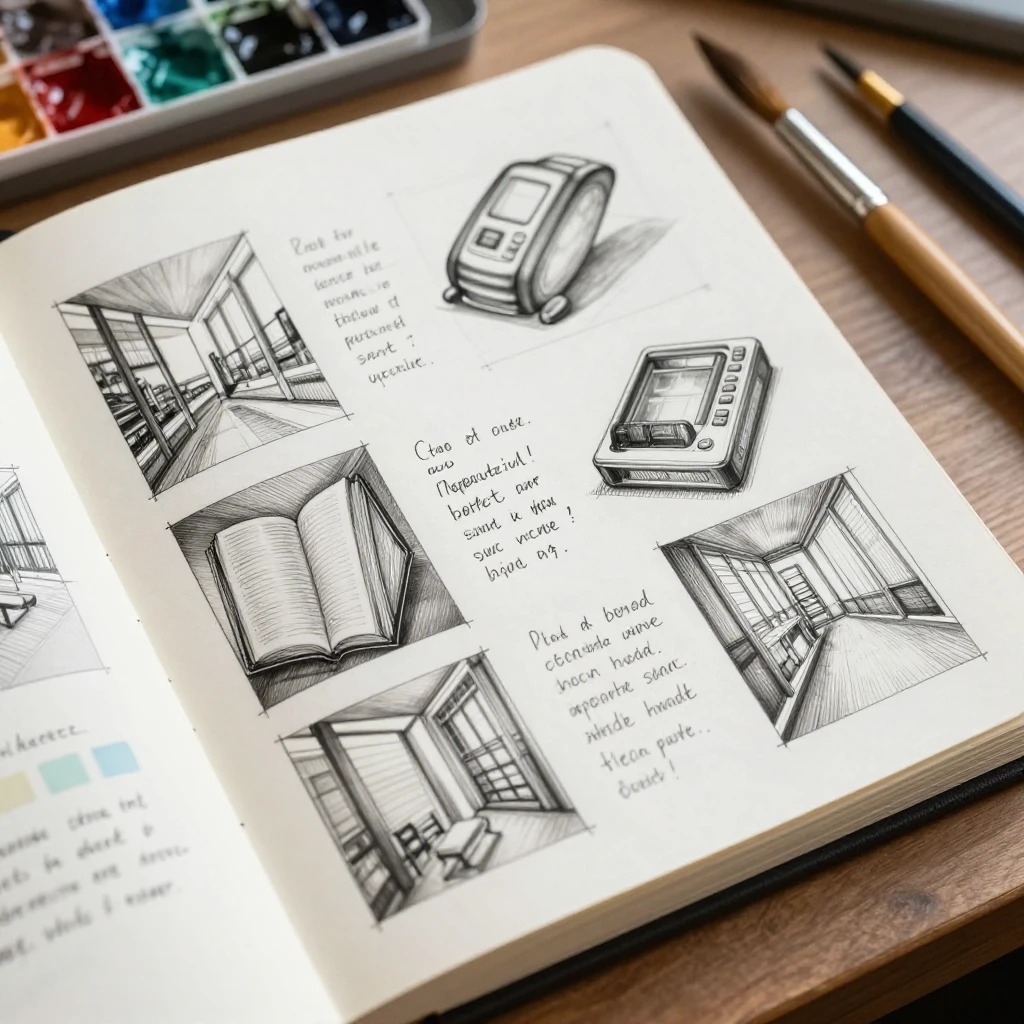
A sketchbook often stays close by, even when the main work is digital or made on a large surface. It can hold quick thumbnails, color notes, questions, or observations that are too rough for a finished piece. Those fragments become part of the studio practice, a record of thinking as well as drawing.
From Idea to Artwork
The creative process moves from an initial idea through tests, decisions, and revisions before an artwork feels resolved. Professional artists often work through uncertainty by making small, low-cost experiments before committing to a final surface or format.
An idea may come from a client brief, a visual detail noticed on a walk, or a question the artist has been exploring over several pieces. Rather than waiting for a complete vision, the artist can start with a few thumbnail sketches. These quick studies test scale, shape, and composition. A limited color study or material sample can answer practical questions before a longer session begins.
Once the direction feels promising, the artist develops the work. That stage may involve drawing, painting, editing, layering, printing, or sculpting. Progress is not always visible from one hour to the next. A painter might cover a passage that seemed successful yesterday because it competes with the focal point today. Revision is part of the work, not proof that the idea has failed.
For a commissioned piece, revisions also involve communication. An artist may send a sketch or progress image at an agreed checkpoint, ask a focused question, and record the feedback before making changes. Clear checkpoints help keep the project aligned with the brief. They also protect the artist’s studio time by avoiding repeated, loosely defined rounds of edits.
At the end of a focused session, the useful question is not only “Is it finished?” It may be “What did this pass solve, and what should I test next?” That answer gives the next session a starting point.
The Business Side of an Art Practice
The business side of a professional art practice includes correspondence, commissions, scheduling, recordkeeping, and sharing finished work. These tasks support the creative work, but they need boundaries so they do not consume every studio hour.
Client communication might mean answering a question about dimensions, confirming a delivery date, or sending an invoice. A clear message is usually more helpful than a long explanation: restate the project, name the next step, and give a realistic timeframe. Keeping notes in one place also prevents details from getting lost between email threads and studio pages.
Artists also use part of the week to document work. A good portfolio image should show the artwork accurately, with color and scale represented as faithfully as possible. The artist might photograph a finished piece in even light, record its title and materials, and update a portfolio page or archive. Not every experiment belongs in a public portfolio; selecting work that reflects the artist’s current direction creates a more useful view of the practice.
Administrative work often comes in clusters. Scheduling two short correspondence windows, for example, can be less disruptive than checking messages every few minutes. The trade-off is that clients may wait longer for a reply, so urgent project questions should have a clear route and response expectation.
- Reply to time-sensitive project messages.
- Confirm milestones, delivery dates, and any needed approvals.
- Update project notes, invoices, or the portfolio in a planned admin block.
Breaks, Blocks, and Changing Plans
Breaks and plan changes are a normal part of an artist’s day, not interruptions to an otherwise perfect flow. A short pause can protect concentration, while a change of task can help when a piece has reached a genuine decision point.
Long sessions at an easel or screen can bring on physical fatigue, and tired eyes or hands make careful choices harder. An artist might step away for water, stretch, or look at the work from across the room. The distance matters: a composition that seems convincing up close may feel unbalanced from a few steps back.
Creative blocks also happen. When the next move is unclear, the artist can reduce the stakes rather than demand an immediate breakthrough. Try a small study, revisit the brief, make a material test, or write down two possible directions. These actions keep the creative process moving without pretending that every experiment will become finished work.
Unexpected interruptions can change the schedule, too. A delayed delivery, a client’s urgent question, or a studio problem may require a different order of tasks. A flexible plan has a buffer for such moments. If the main work block disappears, a smaller task such as organizing reference images or preparing tomorrow’s materials can still create useful momentum.
Wrapping Up and Looking Ahead
At the end of a studio day, an artist reviews what changed, protects unfinished work, and writes down the next step. This short closing routine makes it easier to return without spending the first part of tomorrow reconstructing the plan.
The review can be brief: note which areas are working, mark anything that needs another pass, and record questions that remain open. For wet paint, the artist may move a piece to a safe drying spot; for digital work, they may save a version and back up files. Tools get cleaned or set out for the next session, depending on the medium and workspace.
Then comes a practical handoff to tomorrow. A note such as “test the cooler background before adjusting the figure” is more useful than “keep working.” It names a decision and gives the next session a clear entry point. If a commission is waiting, the artist can also list the next client update or deadline so it does not linger in memory overnight.
A finished artwork may eventually appear in a portfolio, but the day’s progress is often smaller: a stronger composition, a resolved color problem, or a clearer plan. Those steps are how a sustained studio practice turns ideas into work that can be shared.
Frequently Asked Questions
Does a professional artist follow a fixed daily schedule?
Some artists keep regular studio hours, while others adjust their routine around teaching, caregiving, client deadlines, or shared workspace access. A consistent start or planning ritual can help, but no single schedule fits every practice.
How much of an artist’s day is spent making art?
It varies with the medium, workload, and stage of a project. A day may include several hours of focused making, while another may be mostly correspondence, research, documentation, or preparation. Finished work depends on those supporting tasks, too.
What tools or materials does an artist use every day?
Common tools include a sketchbook, pencils or digital drawing tools, project notes, and materials specific to the artist’s medium. Painters may use brushes and pigments; digital artists may rely on a tablet and software. The daily kit is personal and changes with the work.
How do artists stay productive when inspiration is low?
They can begin with a defined, manageable task: make a few thumbnails, test a material, review the project brief, or continue a section that does not require a major decision. Structure helps, though it cannot guarantee a breakthrough. Sometimes the productive choice is to pause and return with fresh eyes.