Creating a Narrative: How to Tell Your Story Through Your Portfolio
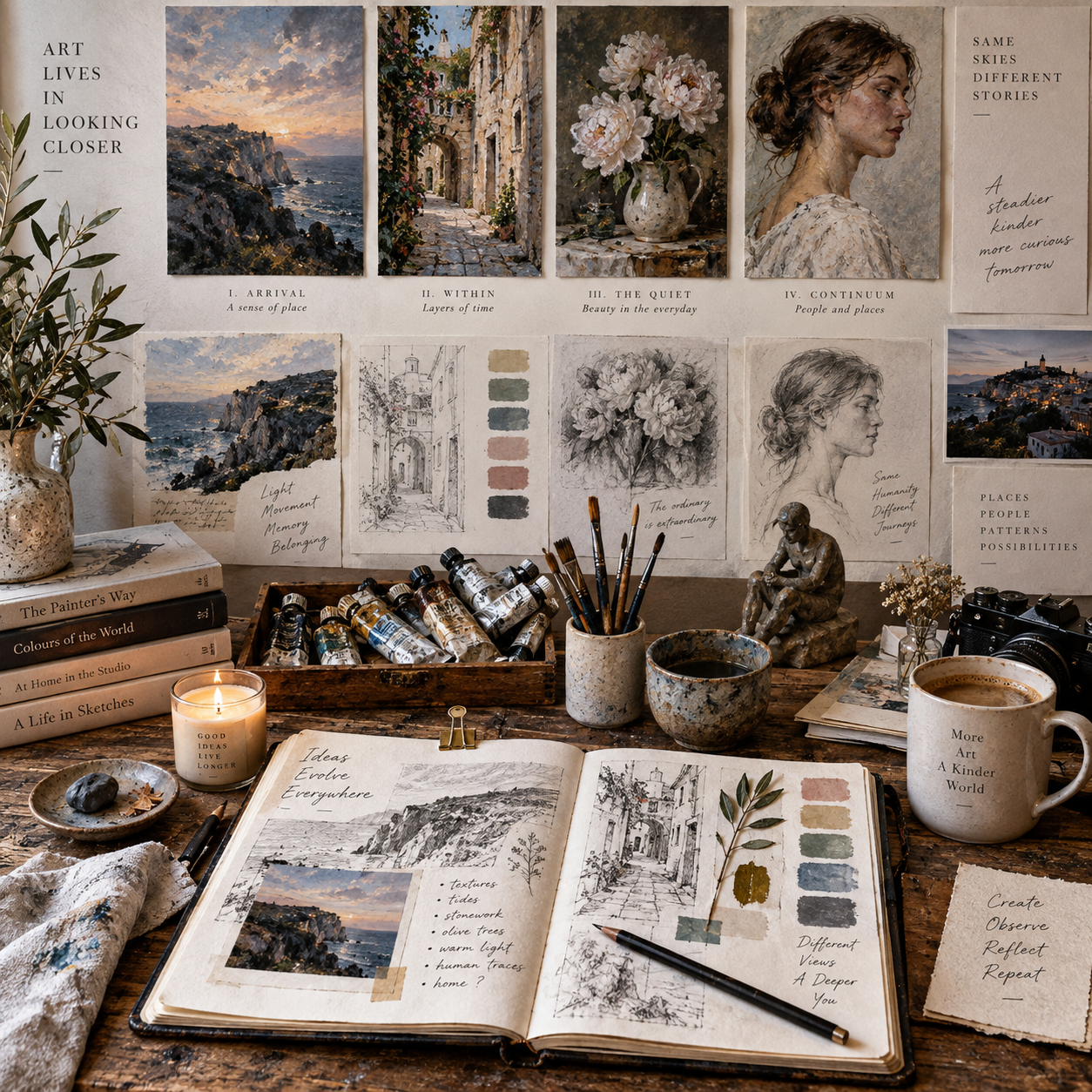
An artist portfolio does more than display finished work. It gives viewers a way to understand your artistic identity, the questions behind your practice, and the relationship between separate pieces. A strong portfolio narrative emerges when artwork, arrangement, text, and presentation work together.
Your story does not need to be dramatic or strictly chronological. It may develop through recurring themes, materials, visual contrasts, personal experiences, or changes in your creative process. The goal is to make the connections within your body of work visible without explaining every possible interpretation.
Why Your Portfolio Needs a Clear Narrative
A portfolio narrative gives context to your artwork and helps viewers recognize the ideas connecting individual pieces. It turns a collection of images into an intentional body of work with a clear viewing experience.
Without a narrative, even strong artwork can feel unrelated. Viewers may notice technical skill but struggle to understand why the pieces belong together or what they should consider as they move through the portfolio. Narrative creates that connective tissue.
Think of the portfolio as a conversation. Each artwork contributes a voice, while the sequence controls when an idea appears, develops, becomes complicated, or pauses. This structure can communicate:
- Recurring subjects, symbols, or visual motifs
- A personal question explored across several works
- The relationship between materials and meaning
- A shift in scale, mood, technique, or perspective
- The artistic goals guiding your current practice
A clear narrative also supports professional review. Curators, educators, galleries, and collaborators often need to understand your practice quickly. They are not looking for a fictional plot. They want evidence of intention, development, and a meaningful relationship among the works.
Choose narrative clarity for understanding, while accepting that some ambiguity will remain. Art should leave room for discovery; the portfolio simply gives viewers a reliable path into it.
Define the Story You Want Your Portfolio to Tell
To define your portfolio narrative, identify the central themes, experiences, questions, and artistic goals that connect your strongest work. Write this idea in one or two plain sentences before selecting and arranging images.
Start with the work rather than an idealized biography. Review your recent pieces and ask what keeps returning. You might find an interest in inherited memory, urban change, bodily vulnerability, environmental loss, domestic space, or the tension between control and accident.
Use these questions to locate the center of your story:
- What subject or concern appears repeatedly, even when the medium changes?
- What do I want viewers to notice, question, or feel?
- Which experiences inform the work without needing to be described literally?
- What have I learned or changed during this period of making?
- Why are these materials, processes, or forms necessary for the idea?
Next, create a working narrative sentence. For example: These paintings examine how family memories change when they are retold through photographs, fragments, and imagined spaces. This sentence is a decision-making tool, not necessarily the final artist statement.
Separate the personal story from personal information. A portfolio does not need to reveal every biographical detail. Instead, explain how an experience shaped the work’s imagery, method, or questions. That connection makes the story relevant to the artwork.
Your narrative may be thematic rather than chronological. A series can move from quiet to intense, from detail to distance, or from recognizable imagery toward abstraction. What matters is that the structure reflects the intended viewer experience.
Choose Artwork That Supports the Narrative
Choose artwork that advances the central idea, maintains a convincing level of quality, and contributes something distinct to the body of work. A piece should earn its place through relevance and function, not simply because it is recent or visually attractive.
Begin with a broad selection, then edit in stages. Gather more work than you expect to use, including pieces that may reveal an important transition. Afterward, evaluate each one with a practical scorecard:
- Relevance: Does the work connect to the portfolio’s main theme or question?
- Contribution: Does it add a new perspective, material, scale, or emotional register?
- Quality: Does it meet the standard set by the strongest pieces?
- Connection: Does it create a useful relationship with the works around it?
- Necessity: Would removing it weaken the narrative or improve its focus?
Do not confuse visual cohesion with repetition. Related work can share a palette, process, subject, or atmosphere, but every image should not make the same point. A quieter piece may provide a necessary pause. A difficult or unresolved work may show the question becoming more complex.
When a piece is excellent but unrelated, save it for another portfolio or a separate project page. Protecting the portfolio’s focus often matters more than showing your full range.
A useful test is to write one sentence about the role of each artwork: introduction, evidence, interruption, development, contrast, or resolution. If you cannot describe its role, the piece may need stronger context or may not belong.
Sequence Your Work for Meaning and Flow
To sequence artwork effectively, give the portfolio a purposeful opening, a developing middle, and a closing image that leaves the viewer with a clear final impression. Artwork sequencing should create relationships, not merely arrange files in upload order.
The first piece establishes expectations. Select an image that represents the quality and concerns of the portfolio while offering enough visual interest to invite continued viewing. It does not always need to be the loudest or most dramatic work.
The middle can develop the narrative through progression and contrast. Consider arranging pieces by:
- Increasing or decreasing scale
- Movement from familiar imagery to abstraction
- Changes in color, light, texture, or density
- Expansion from an individual experience to a wider social question
- Alternation between intensity and visual rest
The final piece should feel deliberate. It might echo an earlier image, open a new question, or provide a quiet image that continues to resonate after the portfolio ends. A conclusion does not have to solve the story.
Test multiple sequences rather than trusting the first arrangement. Make three versions: one based on chronology, one based on visual rhythm, and one based on conceptual development. Compare what each version makes visible.
For a digital portfolio, review the sequence at the size and speed a viewer will actually experience. Large gaps, inconsistent image proportions, or abrupt shifts in documentation can interrupt the flow. A strong sequence can lose its effect when the presentation feels accidental.
Connect Your Images, Artist Statement, and Process
Your artist statement should explain the portfolio’s central concerns and methods, while images and process details provide the evidence. The strongest connection occurs when text adds orientation without dictating exactly what viewers must see.
Write the artist statement after you understand the selected body of work. Describe what you investigate, how you make the work, and why those choices matter. Avoid broad claims such as my art expresses life unless you immediately specify the subject, experience, or formal strategy involved.
Useful context may include:
- The question or tension driving the series
- The role of a particular material, tool, or technique
- How observation, research, memory, or experimentation enters the process
- The change you want viewers to notice across the portfolio
Captions should be accurate and economical. Include the title, date, medium, and dimensions when relevant. Add a short note only when information materially affects interpretation, such as a process involving found photographs, site-specific materials, or a collaborative method.
Process images can deepen the narrative when they reveal decisions rather than decorate the page. A sketchbook page, material test, installation view, or studio photograph may show how the work developed. Select these details carefully. Too many can make an artist portfolio feel like an archive instead of a focused presentation.
Keep the visual story in charge. If viewers must read several paragraphs before they can reach the artwork, the balance has shifted. Use the College Art Association’s professional guidelines as a useful reminder to present artistic information accurately and responsibly.
Refine the Portfolio for Clarity and Cohesion
Refine an artist portfolio by removing distractions, standardizing presentation, and checking whether each transition supports the intended narrative. Editing usually strengthens a portfolio more than adding more artwork.
Review the portfolio in four passes:
- Concept: Can a viewer identify the main concern without being given a private backstory?
- Selection: Does every artwork contribute a necessary function?
- Presentation: Are images consistently photographed, cropped, labeled, and displayed?
- Experience: Can viewers move through the portfolio without confusion or unnecessary effort?
Image quality has narrative consequences. A dark photograph beside a bright, accurately color-balanced image creates an unintended break. Check focus, glare, color, scale, margins, and installation documentation. If the original work depends on texture or size, include details or contextual views rather than relying on one flat image.
Spacing also affects pacing. Crowded pages can make distinct works compete, while excessive empty space may make related pieces feel disconnected. Use spacing to create pauses and emphasis.
Ask one trusted viewer to describe the portfolio after seeing it once. Record the words they use, the work they remember, and where their attention changed. Their interpretation does not need to match yours perfectly, but repeated confusion often identifies a structural problem.
Revise with purpose. Choosing a shorter portfolio for clarity means accepting that some strong work will remain unseen in that particular presentation. That is a strategic choice, not a judgment on the excluded pieces.
Common Portfolio Storytelling Mistakes to Avoid
The most common portfolio storytelling mistakes are weak sequencing, excessive explanation, unrelated artwork, inconsistent presentation, and prioritizing quantity over purpose. Each mistake makes it harder for viewers to understand the body of work.
1. Treating the portfolio as a biography
Why it happens: Artists assume personal history automatically explains the work. Consequence: Viewers receive background information but cannot see how it shapes the images. Correction: Connect each biographical detail to a specific subject, material, decision, or recurring visual element.
2. Using a weak or accidental sequence
Why it happens: Files are arranged by date, convenience, or upload order. Consequence: The portfolio feels flat, and important relationships remain hidden. Correction: Test sequences based on progression, contrast, rhythm, and emotional impact.
3. Explaining every artwork
Why it happens: The artist wants to prevent misunderstanding. Consequence: Dense text competes with visual discovery and leaves little room for interpretation. Correction: Explain the larger investigation, then use brief captions for essential context.
4. Including unrelated work to show versatility
Why it happens: Variety feels like proof of skill. Consequence: The central narrative becomes difficult to identify. Correction: Create separate portfolios or clearly labeled bodies of work when the projects require different contexts.
5. Prioritizing quantity over purpose
Why it happens: A longer portfolio can seem more impressive. Consequence: Repetition dilutes the strongest images and increases viewer fatigue. Correction: Keep work that advances the narrative, even when that means presenting fewer pieces.
Frequently Asked Questions About Portfolio Narratives
How many artworks should an artist include in a portfolio?
There is no universal number. Include enough work to demonstrate a coherent body of work, often around 10 to 20 pieces for a focused digital portfolio, while adjusting for medium, purpose, and application requirements.
Should a portfolio show one body of work or multiple styles?
A focused portfolio is usually easier to understand, but multiple styles can work when they share a clear artistic identity or are organized into distinct series. Do not force unrelated projects into one narrative.
How does an artist statement support a portfolio narrative?
An artist statement names the concerns, methods, and questions connecting the work. It should provide context for the images while leaving viewers enough freedom to form their own responses.
What should be the first and last piece in a portfolio?
The first piece should establish quality and invite attention. The last should create a meaningful closing impression, whether through resonance, contrast, or an open question.
How often should an artist revise a portfolio?
Review it whenever a significant new series develops, before an important application, and at least once or twice a year. Regular editing prevents outdated work from weakening the current narrative.
A compelling portfolio narrative grows from deliberate choices: what you include, what you leave out, how the work unfolds, and how much context you provide. Start with the questions driving your practice, then let selection, artwork sequencing, and portfolio presentation make those questions visible.